Why Soil Classification Matters
Classification isn’t paperwork for its own sake. It affects your project in three ways:
- It drives the disposal or reuse pathway. The classification decides where the soil can go, how it must be handled and what it will cost.
- Facilities require it. Licensed facilities won’t accept material until they have evidence of what it is and that it meets their acceptance criteria.
- It’s a legal obligation. Under the NSW EPA’s Waste Classification Guidelines and the Protection of the Environment Operations Act 1997 (POEO Act), the waste generator is responsible for classifying their waste. It’s also an offence to transport waste to a place that can’t lawfully receive it, and that liability can extend to the waste owner as well as the transporter.
The Main Soil Classifications in NSW
The POEO Act recognises six waste classes: special, liquid, hazardous, restricted solid, general solid (putrescible) and general solid (non-putrescible). For excavated soil, the categories you’ll meet most often are below. One of them, ENM, isn’t a waste class at all but a reuse pathway, so it’s grouped separately.
Waste classes
VENM (Virgin Excavated Natural Material). Natural material such as clay, gravel, sand, soil or rock fines that has been excavated from areas not contaminated with manufactured chemicals or process residues from industrial, commercial, mining or agricultural activities. It must contain no sulfidic ores or soils, and no other waste. Naturally occurring asbestos also rules it out. VENM is pre-classified as general solid waste (non-putrescible), which is why it offers the most flexibility.
General Solid Waste (GSW) soil. Soil that has been chemically assessed and falls at or below the EPA’s general solid waste thresholds for contaminants. It can typically go to a facility licensed to accept it.
Restricted Solid Waste (RSW). Soil with contaminant levels above the general solid waste thresholds but within the restricted solid waste limits. It needs more controlled management, and many landfills aren’t licensed to take it.
Hazardous Waste soil. Soil with contaminant levels above the restricted solid waste limits, or soil with hazardous characteristics. Hazardous waste can’t be disposed of in NSW without treatment first, so it’s the most tightly regulated pathway.
Special waste. Soil containing asbestos is special waste, with its own handling, transport and disposal requirements, including EPA tracking in certain cases.
A reuse pathway: ENM
ENM (Excavated Natural Material). Naturally occurring rock and soil that is at least 98% natural material by weight and doesn’t meet the VENM definition. Under the EPA’s ENM order and exemption, it can be reused as engineering fill or in earthworks, but only if strict conditions are met. The material must be sampled and tested by a NATA-accredited laboratory, supplied with a written statement of compliance and backed by records. ENM excludes hotspots, processed material, and material containing asbestos or acid sulfate soils.
Always confirm current definitions and thresholds against the EPA’s Waste Classification Guidelines and the ENM order.
The Classification Process: Step by Step
Step 1: Site history assessment (desktop review)
The process starts at a desk, not in a lab. A review of the site’s past uses, such as former industrial activity, fuel storage, fill importation or agricultural practices, indicates what contaminants might be present. For many sites this step shapes everything that follows.
Step 2: Environmental Site Investigation (ESI), if required
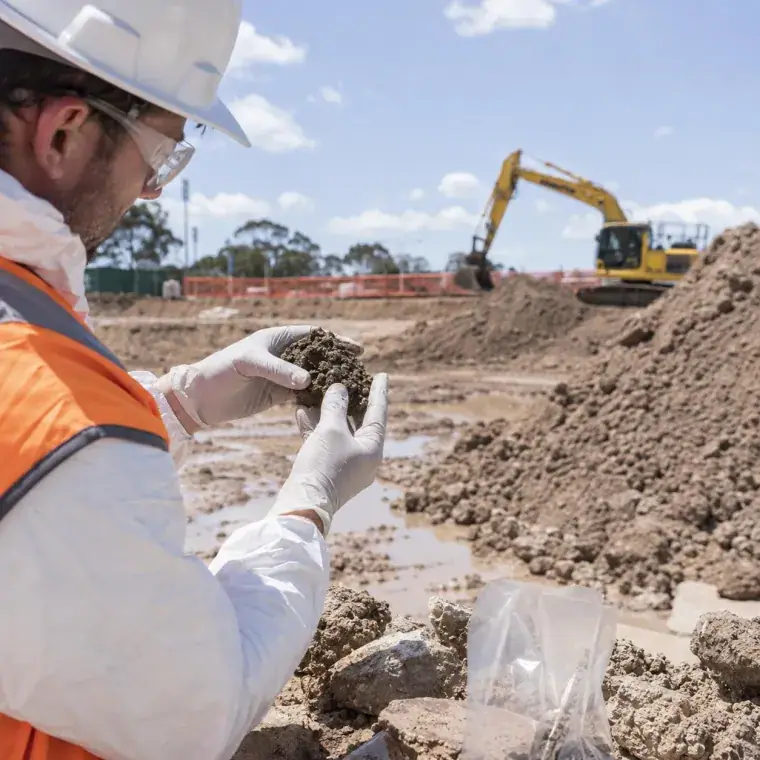
If the history suggests potential contamination, or the information is incomplete, further investigation follows. Consultants may describe this as a preliminary or detailed site investigation. It involves a sampling plan, borehole or test pit work and field observations of the soil.
Step 3: Laboratory testing
Where contamination is suspected or confirmed, samples go to a NATA-accredited laboratory. The analytes depend on the site’s history and may include metals, hydrocarbons, PAHs and pesticides. Asbestos, PFAS and acid sulfate soils each have their own requirements.
Step 4: Consultant interprets results against EPA thresholds
Results are compared with the EPA’s contaminant thresholds, which use both specific contaminant concentrations and leachable concentrations. This step requires professional judgement, because sampling design and soil variability both affect how reliable the result is.
Step 5: Waste classification determined and documented
The soil is assigned a classification and the reasoning is written up. That documentation is what you present to facilities, haulers and, if needed, regulators. Note that soil that hasn’t been chemically assessed defaults to hazardous waste, which is one more reason to test.
Who Determines the Classification?
The legal responsibility sits with the waste generator, but in practice the work is typically carried out by an environmental consultant or qualified site assessor who plans the sampling, interprets the data and signs off on the outcome.
That’s where EBH Environmental fits in. We work alongside consultants to confirm acceptance criteria with facilities before excavation begins, so the classification on paper translates into a smooth, practical pathway on site. Our focus is classification-led disposal, approved facility acceptance and documented transport, supported by ISO certifications and a commitment to sustainable outcomes.
What Documents Are Needed?
The paperwork varies from project to project, but expect some or all of the following:
- ESI report. Records the investigation, sampling and results.
- Remedial Action Plan (RAP). Relevant where contamination must be managed or remediated as part of the works.
- Waste tracking documentation. Ordinary soil isn’t generally tracked, but tracking applies to asbestos waste above set thresholds, hazardous and other trackable wastes, and some waste leaving NSW. Your consultant or EBH can confirm what applies.
- Facility acceptance criteria. The conditions a receiving facility sets for the material it will take, ideally confirmed in writing before loads move.
Keeping these together from the outset makes audits, reporting and client handovers much simpler.
Common Mistakes Contractors Make
Assuming soil is clean without a site history check. Soil that looks clean isn’t necessarily clean. Former land uses and previous filling can introduce contamination that isn’t visible on the surface.
Not confirming acceptance criteria with the disposal facility before excavation. A classification is only useful if the receiving facility will accept the material. Confirming criteria early avoids rejected loads, return trips and idle machinery.
Misclassifying ENM as VENM. The two are easy to confuse, but they carry different obligations. VENM must meet the statutory definition, while ENM can contain a small proportion of non-natural material but must be tested, certified and used within the conditions of the EPA’s order. Treating ENM as VENM can put your project out of compliance.